I changed the title of my manuscript. Escape from Iasse is now The Messenger. The Messenger is 78,000 words long right now. I have another re-write planned, to incorporate what I learned at OYAN.
Tuesday, July 8, 2014

Monday, May 26, 2014
My first Writing conference.
It is settled. I am going to the One Year Adventure Novel Conference in June. The path to get here had been long and tedious. First I had to raise money. I found sponsors who so very kindly financed me all I needed and above. Then, when we sat down to register, we found out you had to have done the OYAN curriculum. So, with the extra money we bought the curriculum. I'll do it over the summer. Just from skimming over the textbook I've learned much. I registered this week. I am supposed to bring four exerts from my novel for the student critiques.
I have no idea what this is going to be like. I might be embarrassed because I haven't done the program. My novel might not be allowed in the student critiques because it wasn't done with the curriculum. God only knows. He got me this far.
Here are some interesting facts.
- The conference is five days long.
- So far, more boys have registered than girls.
- It is for homeschoolers only.
- It is at at the MidAmerica Nazerene University , and I will be sleeping in the dorms. Yay!
- Speakers include Author Daniel Schwabauer, Agent Amanda Luedeke, Editor Jeff Gerke, Proffessor Mark Wilson, and Author Jill Williamson.
- Rumors state that you dress as your character on the first day. I have no costume. Sigh. I really want to dress as my villain.
Wednesday, March 26, 2014
A Brief History of Altesea, Part 3. (Many Dead Monarchs.)
Beru's descendants endured all kinds of tribulation. It became said that all Tiberi died violent deaths. Beru was pushed of the castle wall and either was smashed on the cliffs below or drowned in the ocean. His grandson was bitten by a snake that had taken up its residence in the royal bathtub. In the early eighteenth century King Jonathon III was murdered, and his son, King Caleb, died after falling down a flight of stairs and impaling himself on a broken balustrade. His son, Christopher II was thrown from his horse while racing with his advisers. He cut his forehead, and the doctors were unable to stop the bleeding. Many people said that Christopher's friend, Richard Crusanal, had given him poison to thin his blood. Christopher's infant son, Ellyanus, disappeared three months later, and returned after twenty seven long grueling years under Richard. In the twenty-second year of his reign, he was assassinated by a terrorist out of El Ahir. West Altesea got mad at everyone, and seceded west of Glagnafrita. Ellyanus's stepson, King Josiah, who still ruled eastern Altesea, abdicated two months into his reign and set up a republic. He lived to the ripe age of ninety-four.
Saturday, February 15, 2014
Castles Part 5- The Rosetta In Aethahil
So, on to the most important of my castles, the Rosetta in Aethahil, the palace of King Ellyanus and the Tiberi kings. I've waited months to do this, because of the magnitude of the information I know about it.
History of The Rosetta
The earliest Altessi Kings dwelled on the cliffs of Aethahil. They called their house a palace, but it was really a glorified thatch shack. It was burned when Aethahil was captured, and a garrison was built on the spot by the invaders. When the Alteseans drove out their masters they set up government headquarters in the garrison. Over the years they expanded it, and turned it into a palace. King Christopher I, around the year 1378, came into a huge sum of money, (I don't know how he got it,) and built himself a palace. With strong foundations and structure, the outside was covered in marble, so it would gleam in the sunlight. Above the three story main halls it had five towers ranging from four to five stories tall. On top of five hundred foot cliffs, that's a freaking tall castle. I try to be realistic in my imagining, but I get greedy. Hmm...I wonder what the wind is like up at the top. Anyhow, King Ellyanus Tiberi's office was on the seventh floor in the west tower. When he was working on king stuff, if anyone wanted to see him, they would really have to really want to see him. Those carrying trivial matters got tired after four or five flights of stairs.
These cliffs in Normandy are the way I imagine the Aethahil cliffs. However, the Aethahil cliffs are 500 feet at the most, and the Etretat are 1700 feet. Imagine the castle up on that outcropping, and the city sprawling on terraces from the plateau down to the beach.
 |
| White Cliffs of Etretat, In Normandy |
 |
| View from a hotel in Positano, Italy. I do like terraced towns. |
 |
| More Positano |
 |
| The Sparrows Nest, on the Crimean Peninsula of Ukraine. A tiny little castle that gives you an idea of the view from The Rosetta. |
 |
| Mont St Michael,m in Brittany. |
King Christopher I designed in Neoclassicism before it was cool. Surrounding the courtyard of his palace he built stoas, some twenty feet tall. The gardens were renowned among the nations, and in 1792 a swimming pool was built, some seventy five feet long, twenty feet wide, and twenty feet deep.
 |
| Greek Stoa. |
 |
| The Salt Palace Convention Center in Salt Lake City. In my visit there I was so impressed with the architecture I thought it ought to be a palace. |
The palace wasn't finished in Christopher I's lifetime. His great-great-great-great-grandson watched the last pane of glass in the throne room laid in place. By then the royal funds were getting low. This guy, King Robert, or Bob, shied away from gems, paneling, and red carpets. He preferred to imitate the beauty of creation and the glory of its Creator, rather than his own wealth. The walls were painted white, so light was abundant, and the pillars were fashioned to resemble trees holding up the roof. I guess he took a leaf a out of Gaudi's book.
The ceiling of the throne room was vaulted glass, to let in the sunlight of clear Aethahil summers. In 1789 the roof was reinforced with steel beams, a new and amazing invention, though hardly as powerful as modern ones. Also, chandeliers were suspended from the beams to light the room at night.
The thrones themselves were delicately fashioned of ivory, and were reputed to be very uncomfortable.
 |
| Gaudi's Sagrada Familia. Josiah thinks the tree pillars look like bones. I think the floor plan resembles the Rosetta. |
Friday, February 14, 2014
The Flag of Altesea

Shapes: The three stars represent the three traditional provinces; and the sea, fields, and mountains. The two diagonal banners possibly represent the two ancient watchtowers between Glagnafrita and Aethahil, Gedullah and Ballahah.
Colors: The red stands for blood shed in defense of country. (Of course.)
The white stars mean that the people will strive to be a nation pure in heart.
The blue background represents the sea, heaven, sky, and other pretty blue things.
The yellow banners: Gold is the color of wealth, so the yellow perhaps signifies the great natural resources of Altesea. Also, it could represent the abundance of small yellow flowers that grow on the peninsula. When crushed, these flowers heal wounds.
The Provinves.
Each color represents a different province.
Red: West-southwest, with Vinum as capital. The west has had constant warfare for the last thousand years. And they are the number one producers of wine.
White: East-northeast, with Green Field as capital
Blue: North-northwest, with Mary's Hill as capital. The hill country, they are proud of their open skies.
Yellow: South-southeast, with Aethahil as capital. Those yellow flowers on the peninsula are famous for their healing ability.
Saturday, February 1, 2014
What Do You Do When Your Genre Doesn't exist?
There is an exceeding number of book genres in existence. And those genres have sub-genres. Romance runs the gamut from Amish and bonnets, to sleezy stuff on the racks at gas stations and dollar stores. History can be almost everything. And then there is dystopian, The Hunger Games, When Atlas Shrugged, 1984.
Fantasy can be high fantasy, with elves and orcs and epic battles between good and evil- Lord of the Rings, Eragon, Blood of Kings. Or fantasy can be low-fantasy, where odd things happen in our own world--Twilight, Harry Potter, most fairy tales, the Arabian Nights. And then there is a bunch of weird fantasy novels for adults living in their parents basements. No offence to those of you who have found gems in all the weird stuff out there.
I have spent much time researching the genre of my novel. Some fantasies have dragons and trolls, but nobody can do magic. My people don't have dragons. There is no magic, but rather railway engines and telegraph wires. And everybody is human, no elves and dwarfs. That excludes it from high fantasy. It isn't Victorian or Edwardian, so it isn't steampunk. My people don't even have zeppelins. I felt a little hopeful when I discovered a book series with the genre of Gunpowder fantasy. I thought, "Hmm, this is closer." Nope. That book was about elvish Napoleons, and wizards firing off cannons. What do you call a book set in an early-mid 1800's world that has no magic and worships a Judeo-Christian God? After two years I have come to the decision that my genre doesn't exist...yet. I just have to invent it.
The path to inventing a genre is a tough one. I entered my story in a contest. One of the judges said my combination of another world, medieval castles and civil war technology was strange. She basically said, "Who attacks a castle with cannons?" People did it all the time in the 1600's. Another person said that my names, so normal, felt out of place in another world. I don't know if the judges were right. Personally, I dislike fantasy books with long unpronounceable names. I find it distracting.
My comfort is that most of those best-selling series out there are new genres some brave author invented.
Nobody had heard of dystopian for teens until Suzanne Collins wrote The Hunger Games.
Publishers rejected the story of a boarding school for wizards twelve times. And now, Harry Potter is still a favorite.
Since when do vampires and humans fall in love? The wildly successful Twilight.
If you can come up with a strange new idea, you can probably sell it. I hope. :-)
Tuesday, January 28, 2014
Ermengilda's kitten
Ermengilda climbed off the tall horse. Her slippers crunched on the frozen snow, and a sweet breeze tugged her hair free of its net. With a groan of cold Aunt Mildred tied the horse to a tree and hurried after Gildy through the Scots pines. Mildred walked with stiff tread, but Gildy danced. “Dearheart,” the aunt called. “You are walking too fast. You will fall in the snow and catch your death of cold. Careful on the bridge!”
Gildy scooped up some snow, formed a ball, and threw it at Mildred. “Mildred, you are too fussy.” She wiped her wet hand on her soft red cloak. She turned her face to the wind, closed her eyes, and sniffed the air, which was rich with the pines. “Isn't the wind beautiful?” Mildred buried her near frozen hands in her clothes. “I think it very cold.” “I like cold wind. Warm wind makes you sluggish, but a chill wind puts fire into you, and makes you feel you are really alive, and it is a good day to be alive.” Ignoring Mildred she laid down in the snow and made angels. Mildred sighed, and sat down on a clear patch beneath a tree. Gildy crept behind her, and shook the branches of the pine, dropping snow on her aunt's head. Laughing, she retreated from Mildred's wrath across a low stone bridge. There she had played all through the spring and summer. Whenever she had wanted to get away from the smoke and laughter of her father's longhouse she would come here, to sit by the brook and think, or gather yellow cowslip and burnt orchid. Now, the world was blue and white and gray and...orange? A fluffy orange ball lay in the snow some feet away. Now, it moved, and meowed. A kitten! Gildy approached, and held out her hand. It stretched a long neck toward her, shivering. She ran her hand down its spine and felt every bone. She picked it up around the middle, and it did not fight her. Tucking her cloak tight around her, she held the kitten close. “Oh, you look so cold and hungry. I will keep you, and no one needs to know.”
“Ermengilda, what are you doing over there?”
“I'm coming.” She held the kitten under her cloak and meandered back to Mildred.
“What is the matter?”
The kitten scrambled around, and sunk tiny claws into Gildy's chest. “Nothing is the matter. Can we go home? Ow!"
“Are you alright?”
Gildy twisted her body, trying to dislodge the claws from her clothes without dropping the kitten. “Just a stitch in my side. Can we leave?”
A clatter of hoof beats rang on the road behind. Mildred screamed and threw Gildy on the ground. “Danes!” She drew her sword and stood astraddle Gildy. Gildy arched her back so as to not crush the kitten beneath her.
The clattering stopped, and a bridle jingled. “What are you doing in the snow?”
Gildy looked up from beneath her aunt's foot. A black horse stood before her, champing its bit. And on the horse was a man. His saex was at his side, and he wore his helm. He pulled off the helm to reveal the kind face of Gildy's uncle Cynefrid. “What are you doing?”
Mildred yanked Gildy to her feet. “We thought you were the invading host.”
Cynefrid smiled through his thick beard. “They have not come this far yet. And will never, if King Æthelred can start winning battles.”
Gildy squeezed the kitten by the scuff of the neck. If only it would stop clawing and meowling. “Why do you come here, uncle? I thought you were waging battles in East Anglia alongside Prince Alfred.” Cynefrid stared at the bulge in her cloak that was the kitten . “Your father invited me. I want to meet your sister's husband.”
“He is one good man.”
Gildy, what is meowing in your shirt?”
Gildy retrieved the kitten and showed it to Cynefrid. “I found a kitten. I will keep him.” Mildred had disappeared into the pines, and now returned with Hrodgar the bay. Gildy put the tiny orange kitten in her uncle's huge hand. “Take him to my home. If I carry him I am afraid I will drop him, or Mildred will see him.” Two hours later they rode up the hill to the long house of Cynemaer Ealdraed, Gildy's father. It was black against the sunset, but the top of the roof gleamed gold. Gildy swung off her horse and ran to the back door. The sounds of singing floated through the door, along with the odor of roasting meat. Her older sister, Leofdaeg, approached with quick steps. Leofdaeg glittered with ornaments and necklaces, and her golden hair hung free.
“Where have you been? Cynefrid arrived long ago.” She began brushing Gildy's tangled hair with her fingers.
“Mildred insisted on taking the long route.” She felt as if her hair would be yanked out by the roots. “Come.” Leofdaeg seized Gildy's wrist with her slender hand and hurried her to the mead hall. Gildy could only hope that she would be as beautiful as Leofdaeg when she was eighteen.
A great cheer rose when the girls entered the hall. Father's housecarls raised their glasses and called out, “Leofdaeg!” The color burned brighter in Leofdaeg's cheeks; she adored being adored by all. She passed around goblets of mead and a three gold torques, before sitting down beside her new husband on the high bench. Gildy crawled up on Uncle Cynefrid's lap. He had been her foster father for her first seven years, and she still felt closer to him than her own father, whom she had only known for five.
Father sat on his little throne at the high end of the hall, looking very much a fierce ealderman of Mercia. The warrior was still in his eyes, as he looked down at his men clustered on the benches around the hearth. “Brother,” he said, turning his gaze to Cynefrid. “How does battle with the Danes fare?”
“Bad, bad. Æthelred lacks the greatness to combat our enemies. Look to his younger brother for that. He is the real hope. Besides, the Danes keep coming. As fast as we defeat them, more arrive on our shores.” “Hmm.” If Father had not lost the use of his left leg in a hunting accident, he would join King Aethelred on the coast as fast as a housecarl could drain a mead glass.
After dinner, Cynefrid reached down to the helmet between his feet and pulled out something warm and fuzzy. “I fed it some milk, and tidbits of meat. That kitten can eat.” Gildy held the kitten and stroked it. It stretched out a tiny paw and flexed its claws. Gildy snuggled against her uncle's chest and hummed, looking at the firelight, and petting her kitten. The next she knew, she was being carried to her room by Mildred. The kitten! Where did it go? Gildy did not have it, so where was it? Oh dear... Mildred tucked the sheepskin over her, kissed her, and left. She climbed out of bed, walked with curled toes across the cold dirt floor to the door, and peaked through a crack. The men were quiet, for the scop played his lyre and chanted stories of dragons and warriors. The orange kitten sat in Cynefrid's lap, gazing wide eyed at the splendor of of the house of Cynemaer Ealdraed. She opened the door just enough to poke her face through, and looked at Cynefrid intently. After a while he noticed, and brought the kitten to her.
She carried it with her back to her little bed and laid on her front, listening to the story. She drifted away to sleep, and her dreams were filled with handsome heroes, terrible winged monsters all going by the name of Dane, and one tiny orange kitten.
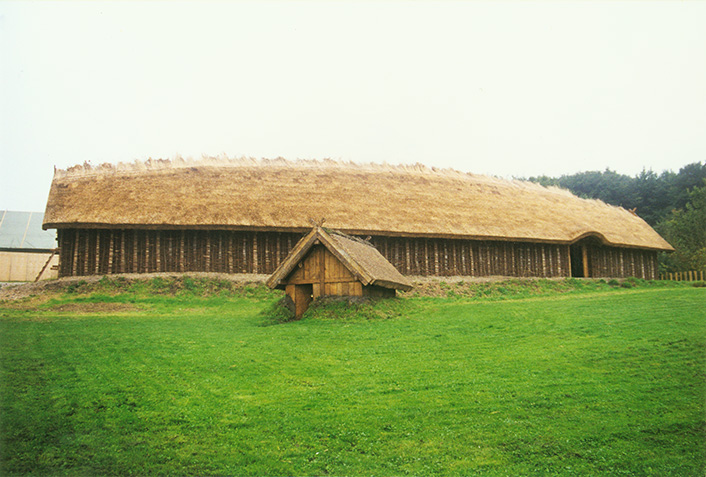 |
| Danish longhouse in Fyrkat, Denmark. An example of the architecture of the time. |
.
Subscribe to:
Posts (Atom)